

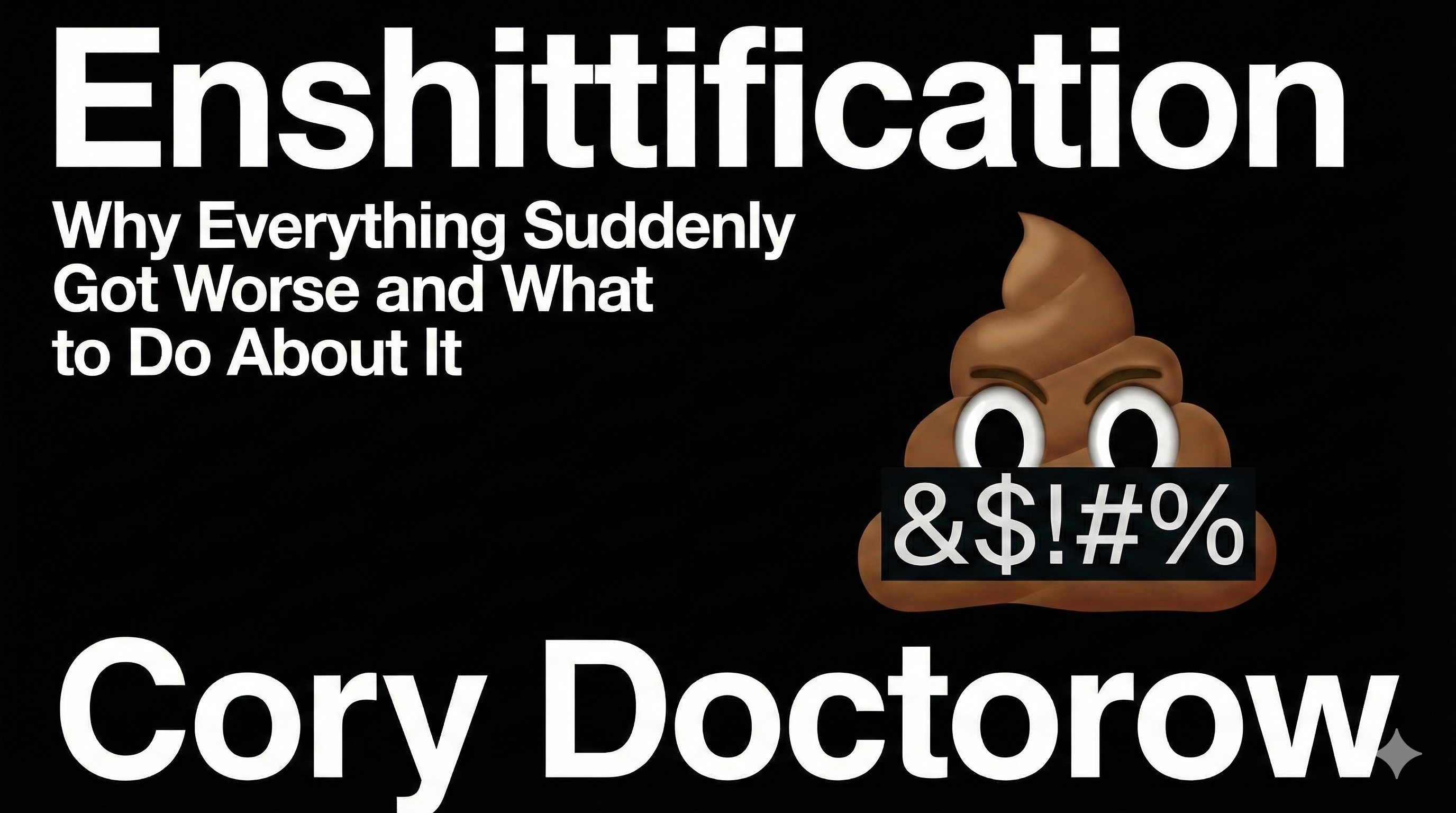
TLDR Summary
Cory Doctorow argues the internet isn’t “decaying” by accident — it’s being systematically degraded by an economic lifecycle he calls enshittification. Platforms tend to follow a three-stage pattern:
Be great to users (subsidize a wonderful experience to lock people in)
Exploit users to favor business customers (advertisers, sellers, publishers)
Exploit everyone to maximize shareholder extraction (ads, fees, pay-to-play, degraded quality)
This happens when four constraints weaken: competition, regulation, interoperability (self-help), and labor power. Doctorow’s “cure” isn’t better CEOs — it’s restoring those constraints, especially adversarial interoperability: the right to make tools that connect to and improve the systems we rely on, so companies can’t trap us.

One-Page Summary
What’s the core idea?
Doctorow’s thesis is that many digital products “rot” in a predictable way because platforms are two-sided markets (users on one side, business customers on the other). Once a platform becomes the gatekeeper between them, it can steadily reallocate value away from everyone else and toward itself.
The three stages (the “natural history”):
Stage 1: Great for users. Investor subsidies fund a clean, high-value experience that builds habit and dependency.
Stage 2: Great for business customers. Once users are locked in, the platform tilts toward advertisers/sellers/publishers to lock them in too.
Stage 3: Great for shareholders. With both sides trapped, the platform extracts rent from everyone: worse user experience + higher business fees + pay-to-play discovery.
Why does this happen now (the “pathology”)?
Because the guardrails eroded. Doctorow says four constraints historically kept firms honest:
Competition (users can leave)
Regulation (penalties for cheating/harming)
Interoperability / self-help (third parties can build alternatives, users can modify/repair)
Labor power (workers can resist harmful choices)
When those weaken, platforms can enshittify without consequences.
How the system “infects” (the “epidemiology”):
Doctorow highlights mechanisms like algorithmic “twiddling” (invisible price/wage tuning), “chickenization” (turning independent workers into controlled, debt-burdened dependents), and using IP/DRM law to enforce what he calls “felony contempt of business model” — making it effectively illegal to repair, leave, or interoperate.
The cure:
The fix isn’t consumer guilt or “vote with your wallet.” It’s reducing concentrated power by restoring the four constraints: stronger antitrust, clear enforceable regulation, legal protection for interoperability/right-to-repair, and stronger worker power.
Extended Summary
Introduction: The Enshittocene
The book opens by identifying a pervasive, visceral feeling shared by almost everyone online: the digital world is decaying. Services that were once beloved, reliable, and essential are rapidly degrading into “piles of shit.” Doctorow coins the term “Enshittification” to describe this specific process of decay. He emphasizes that this is not a mysterious, inevitable force of history, nor is it merely a result of bad technology or “bit rot.” Instead, it is a material phenomenon, comparable to a disease, resulting from specific policy choices and economic incentives that prioritize short-term extraction over long-term value.
