
"The Nvidia Way" Summary: Part 1
From the new book by Tae Kim

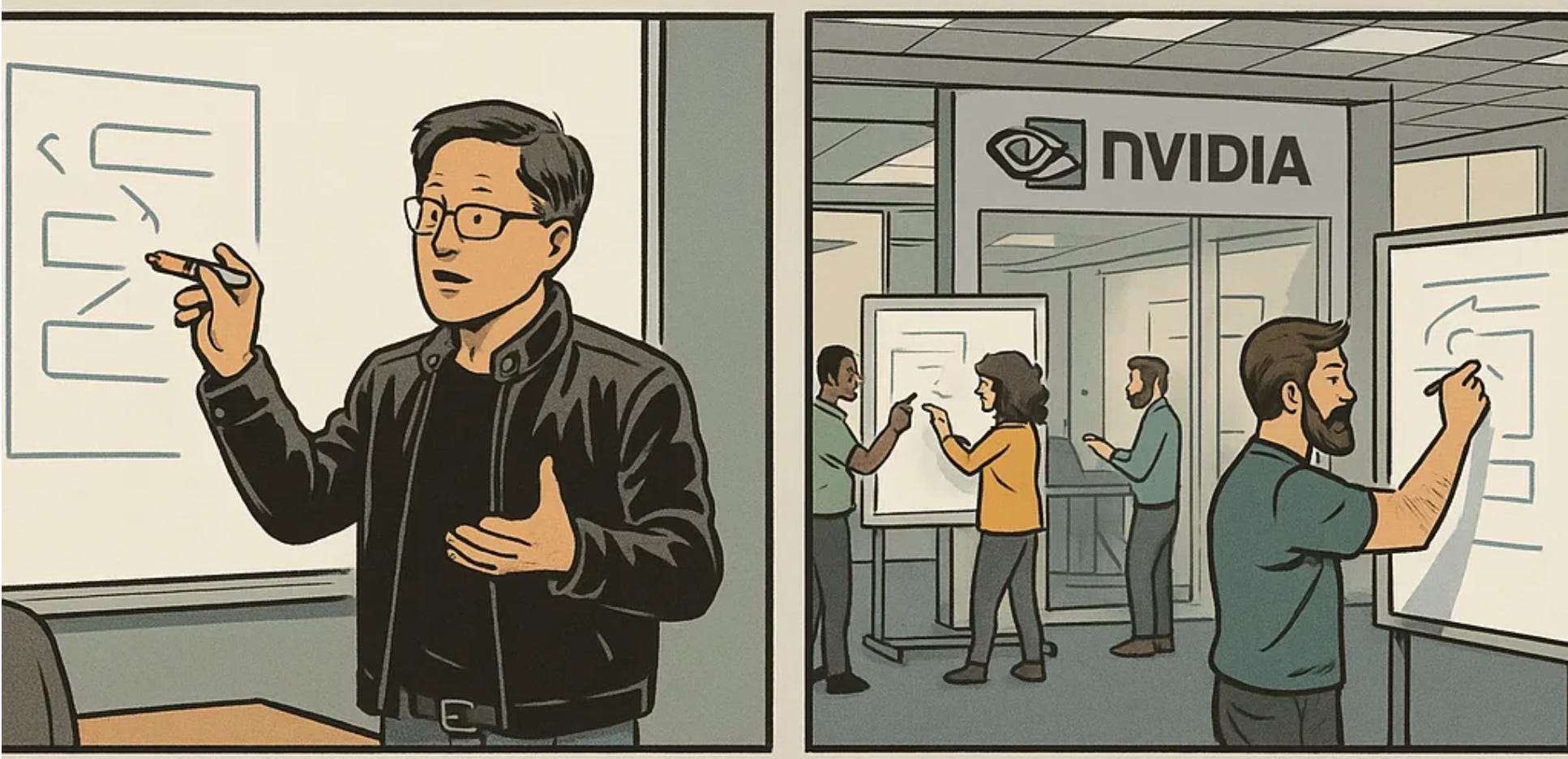
The opening of The Nvidia Way sets the stage with a vivid portrait of Jensen Huang and the unique culture he’s cultivated at Nvidia. At the heart of it is Jensen’s distinct leadership style—part engineer, part educator. The author notes that if he weren’t building chips and companies, Jensen might’ve been a teacher. That’s not just speculation; it shows up in how he runs meetings, often grabbing a whiteboard marker to break down complex problems visually. At Nvidia, whiteboards aren’t just tools—they’re symbols. It’s part of what makes the company feel more like a lab—or even a classroom—than a typical corporate HQ.
The author also introduces Jensen as a character—known simply as “Jensen” both inside and outside the company. His influence has been growing for years, but it really took off when Nvidia’s valuation skyrocketed during the recent AI boom.
Still, even with that spotlight, Jensen tends to downplay Nvidia’s early years. There were plenty of failures—the NV1 and NV2 chip flops, for example—but those stumbles became part of the company’s DNA: learn fast, stay humble, and keep building.

The book isn’t just Jensen’s story, though. Right from the start, the author makes it clear: Nvidia wouldn’t exist without its co-founders Curtis Priem and Chris Malachowsky.
The story of Nvidia is the story of that founding trio—three engineers who took a bet in 1993 and built something that changed the tech world, one chip at a time.
Chapter 1: Pain and Suffering

The story of Jensen Huang doesn’t start in Silicon Valley—it starts with a dream in Taiwan, a suitcase of English words, and a detour through rural Kentucky.
When Jensen was just four, his father returned from a trip to New York City filled with a singular conviction: America was where his sons needed to grow up. It was the land of opportunity, and the family’s future would be shaped there. But like many immigrant dreams, the journey to the U.S. was anything but simple.
